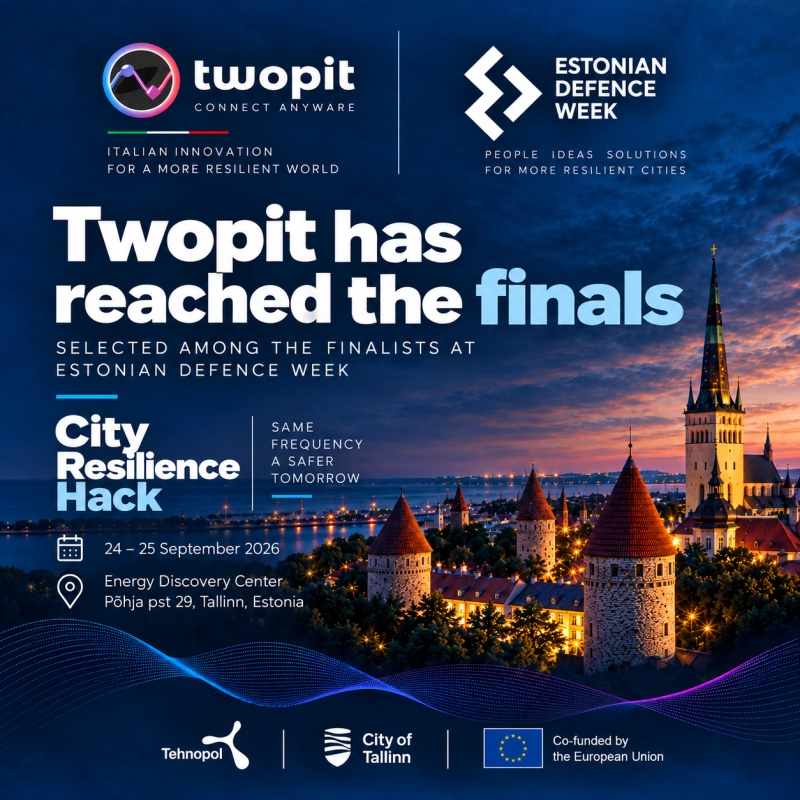
From more than 120 international teams to the Top 10, Twopit brings its vision for geometric modulation, resilient communications and underwater connectivity to the international defence ecosystem.

Twopit at the City Resilience Hack in Tallinn during Estonian Defence Week 2026. Photo via Flickr.
From more than 120 international teams to the Top 10
Twopit reached the Top 10 at the City Resilience Hack in Tallinn, Estonia, during Estonian Defence Week 2026, marking an important milestone in the international development of the project.
More than
120 international teams entered the initial selection process.
Only
37 teams were selected to participate in Tallinn.
Just
17 advanced to the final stage.
Twopit ultimately reached the
Top 10, placing the Italian project among a small group of international teams working on resilience, strategic technologies and next-generation communication systems.
For Twopit, Tallinn represented much more than a competition. It was another step in the transformation of a technology born in Sicily into a project increasingly connected with the international defence, resilience, maritime and emergency-response ecosystems.
A different way of thinking about communication
Twopit was created around a fundamentally different idea of how information can be represented and transmitted.
At the core of the project is
MGC, Modulation through Geometric Coded Models, a communication approach based on coded geometric models used as information-bearing structures within a signal.
The technology was conceived and developed by
Emanuele Costanzo, founder and inventor of Twopit, following years of research into alternative methods for digital communication.
Instead of looking exclusively at conventional parameters such as amplitude, frequency or phase, Twopit explores how
geometry itself can become part of the information representation process.
Twopit describes MGC as the
world's first patented communication architecture based on Geometric Coded Models, introducing a new way of thinking about the relationship between information and the physical signal used to carry it.
The objective is ambitious: to develop new communication possibilities for environments where conventional technologies become constrained, degraded or extremely difficult to use.
From research to real operational environments
Twopit is no longer limited to laboratory experimentation.
The project is already collaborating with the
Italian National Fire and Rescue Service, Corpo Nazionale dei Vigili del Fuoco, on research and experimentation connected with emergency communications and search and rescue activities.
One of the most important areas of development is
underwater communication.
During experimental activities, Twopit progressively moved from transmitting basic digital information toward one of the most important achievements reached by the project so far:
the wireless transmission of digital images underwater. Sending an image underwater represents much more than transferring a file.
It means moving beyond short commands, basic telemetry and simple messages toward information capable of giving rescue teams a direct visual understanding of what is happening beneath the surface.
For search and rescue operations, this could eventually allow teams operating above water to receive increasingly detailed information directly from an underwater operator.
The next challenge: wireless underwater video
Twopit is now working toward an even more ambitious objective:
wireless underwater video transmission. Moving from data to images was already a major technological step.
Moving from images to video introduces an entirely different level of complexity.
Video requires continuous information, greater throughput, greater stability and a communication channel capable of maintaining the transmission over time.
For
Twopit and Emanuele Costanzo, this represents the next frontier.
The goal is to move another step toward something that, in real operational environments, can still appear almost impossible: allowing an underwater operator to send increasingly rich digital information without relying on a conventional physical communication cable.
Images can become sequences.
Sequences can become video.
And video can become real-time situational awareness.
For underwater search and rescue, maritime operations and emergency scenarios, that transition could represent an important leap forward.
Tallinn as an international milestone
Twopit arrived in Tallinn at a particularly important moment in its development.
It was no longer presenting only a theoretical concept.
The project arrived with years of research, a patented technology, prototypes, underwater experimentation and the successful transmission of digital images beneath the surface.
The City Resilience Hack offered an opportunity to confront this work with an international ecosystem focused on resilience, defence, security, critical infrastructure and real-world operational challenges.
Reaching the Top 10 after an initial selection involving more than 120 international teams gave Twopit international visibility and represented an important recognition for the entire project.
But the competition result was only one part of what happened in Tallinn.
New discussions inside the international defence ecosystem
During Estonian Defence Week, Twopit had the opportunity to meet and engage with important figures from the international defence and strategic technology ecosystem.
Among them were
Major General Serhii Kryvonos and
Mario Aguilera, together with other professionals and experts operating across defence, security, resilience and technological innovation.
These meetings were particularly relevant because they created opportunities to discuss Twopit's technology directly with people who understand real operational environments and the challenges associated with communications in difficult conditions.
The contacts established in Tallinn are already opening
new discussion channels around possible applications, technological development and potential future cooperation.
For Twopit, this represents an important evolution.
The question is gradually changing from:
Can this technology work? to:
Where can this technology create a real operational advantage? That transition is fundamental for a technology moving from experimentation toward possible operational adoption.
The team behind Twopit
Twopit is growing around a multidisciplinary team that brings together technology, product development, strategy and international relations.
Emanuele Costanzo is the founder and inventor of Twopit and continues to lead the technological vision and development of the MGC communication architecture.
Maura Santunione represented Twopit in Tallinn, contributing to the international presentation and development of the project during the event.
Gabriele Costanzo contributes to the development of the user experience and visual dimension of Twopit's systems.
Renato Costanzo contributes to project development, coordination and the transformation of technological concepts into structured solutions.
Ciro Polese contributes to the business, financial and strategic development of the initiative.
Together, these different capabilities are helping Twopit evolve from an invention into a broader technological project capable of addressing real-world communication challenges.
Strategic support from 4D Strategic Systems
Twopit's international development is also supported by
4D Strategic Systems, helping the project connect technological innovation with strategic and operational requirements.
An important contribution comes from
Captain Francesco Augenti, whose experience in operational, maritime and defence environments supports the development of Twopit's strategic direction and its relationship with real-world requirements.
For a technology designed for complex environments, this type of support is extremely important.
The challenge is no longer simply to demonstrate that a signal can travel from one point to another.
The challenge is understanding whether a technology can become useful during an actual mission.
It means understanding operators.
It means understanding procedures.
It means understanding difficult environments.
It means translating an invention into something that can provide operational value.
The relationship between
Twopit, Emanuele Costanzo, Francesco Augenti and 4D Strategic Systems is helping to build this bridge between technological research and operational relevance.
From Sicily to the international stage
Twopit's development has followed a progressive path.
It began as an unconventional communication concept developed in Sicily.
It became a patented technology.
It moved through laboratory experimentation.
It was tested through acoustic and radio communication.
It moved underwater.
It transmitted digital data.
It transmitted digital images underwater.
And now the team is working toward wireless underwater video.
At the same time, Twopit is becoming increasingly visible inside international ecosystems connected with defence, resilience, maritime technologies and emergency response.
Tallinn represents another important stage of this journey.
More than 120 international teams. 37 selected. 17 finalists. Twopit in the Top 10. MGC and the future of geometric communication
At the technological core of Twopit remains
MGC, Modulation through Geometric Coded Models.
The concept investigates how coded geometric structures can be used to represent information within a communication signal.
This introduces a different perspective on digital communications.
Instead of asking only how many bits can be transmitted through a channel, Twopit also asks whether
information itself can be represented in a fundamentally different way.
For Twopit, geometry is not simply something that appears after a signal has been decoded.
Geometry becomes part of the language of communication. This is the technological vision developed by Emanuele Costanzo and now being tested across increasingly demanding environments.
The impossible is only the next engineering problem
The next challenges are already clear.
More distance.
More reliability.
More information.
More complex environments.
And eventually,
wireless underwater video.
Twopit is progressively moving from simple data toward richer forms of communication, while at the same time building relationships with organisations, operators and defence professionals capable of testing that technology against real operational needs.
The meetings in Tallinn with figures such as
Major General Serhii Kryvonos and Mario Aguilera, the support of
4D Strategic Systems and Captain Francesco Augenti, the work with the
Italian National Fire and Rescue Service and the contribution of
Maura Santunione, Gabriele Costanzo, Renato Costanzo and Ciro Polese all form part of the same evolution.
At the centre is Twopit.
A technology born from an unconventional idea and progressively being pushed toward environments where communication becomes one of the hardest engineering problems to solve.
From Catania to Tallinn. From sinusoidal waves to Geometric Coded Models. From data to underwater images. From images toward wireless underwater video. Twopit continues to push the boundary of resilient communication.
Because what appears impossible today may simply be the next engineering problem waiting to be solved.